Stablecoin issuance
Early access
Stablecoin issuance is in early access. It's a paid module and is available on request. Contact your Account Manager to get access.
With Layer1, you can issue your own stablecoin. You hold the licence and the reserve
. Layer1 runs the token for you: it mints and burns tokens on-chain, checks every mint against your reserve, and gives your compliance team the controls a regulated issuer needs.With stablecoin issuance, you can:
- Create new tokens and destroy the ones taken out of circulation.
- Require approvals for mints and burns based on the amount.
- Confirm your reserve before every mint through a webhook.
- Freeze an address, then unfreeze it, or seize its funds.
- Pause the token contract on one network and resume it.
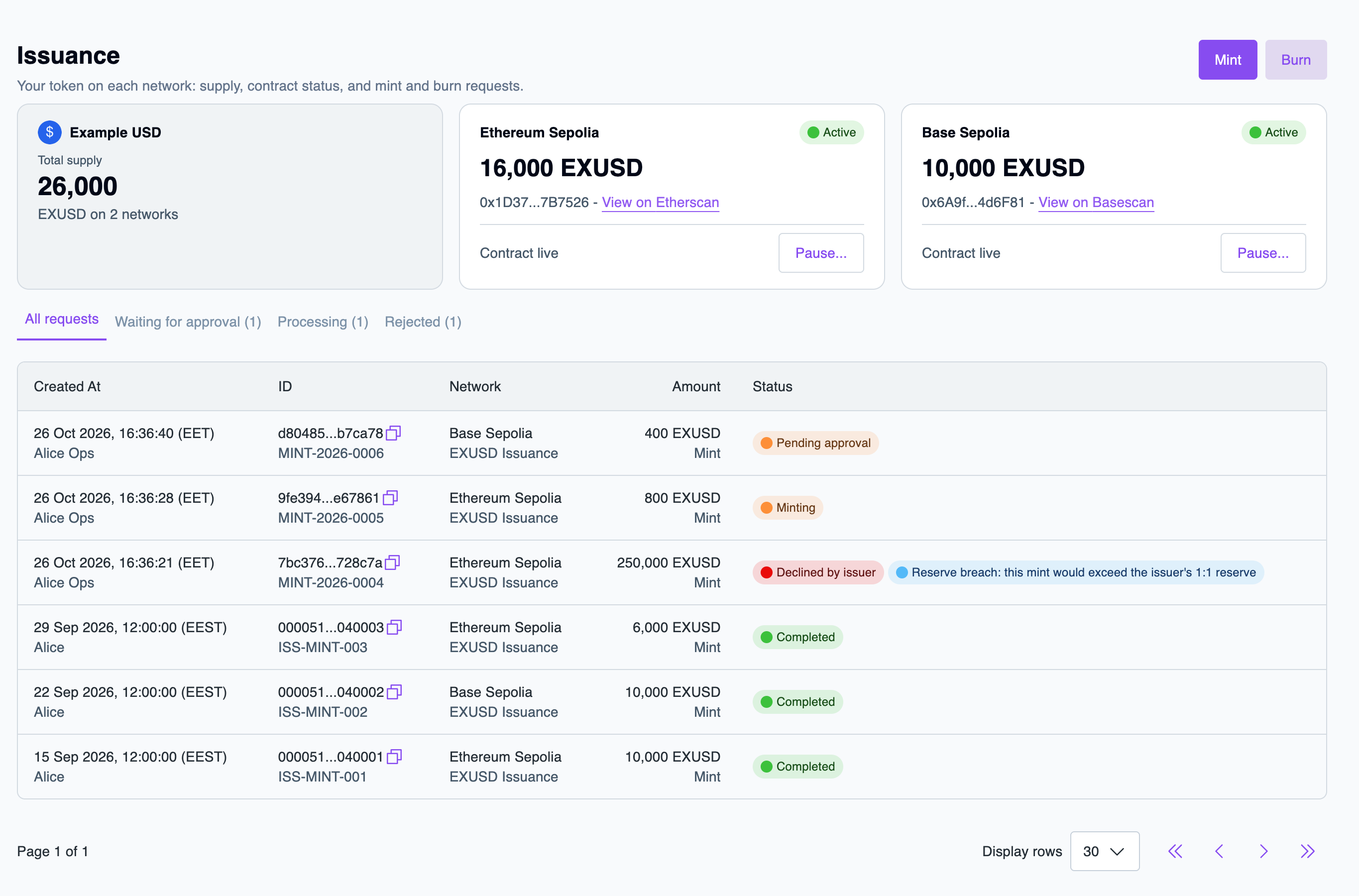
You can do all of this in the Layer1 Portal under Issuance or through the Issuance API.
Key concepts
- Token: your stablecoin, for example Example USD (
EXUSD). The token records the asset that backs it, such as USD, and whether the funds of a frozen address can be seized. - Token contract: the contract of your stablecoin on one network. Your stablecoin can run on several networks, and each network has its own contract. The total supply is the sum over all networks.
- Order: a mint or a burn of your stablecoin on one network.
- Compliance case: a frozen address and every action taken on it.
Get started
- Create a stablecoin with your Account Manager and prepare your team.
- Mint and burn your stablecoin and confirm your reserve before each mint.
- Freeze and seize when your compliance team needs to act on an address.
- Pause a token contract when you need to stop all movement on one network.
To require approvals for mints and burns, see Approvals for stablecoin issuance.
Roles
To use this capability, you must have the follosing roles enabled:
issuance:operator: mint and burn, confirm the reserve, freeze, unfreeze, and seize, pause and resume contracts, and approve mints and burns created by other users.issuance:viewer: view your stablecoin, its contracts, orders, and compliance cases.
For the API scopes behind these roles, see Stablecoin issuance scopes.